






Claims management is the set of processes, tools, and decisions that guide a claim from first notice of loss (FNOL) through resolution. Effective claims management directly influences every major metric for carriers.
In insurance, AI is helping carriers gain a competitive edge in claims management. Today, it’s estimated that 90% of insurers are using AI, but only 52% are using AI-driven claims management to compete and grow. Claims leaders know AI is important, but they often don’t know the most effective ways to apply it to see real business outcomes, fast.
This guide explains what claims management is in insurance and how forward-thinking carriers use Assured’s AI solutions and products to optimize their process. By modernizing claims management with quality data and AI-driven solutions, Assured helps carriers unlock true downstream automation.




Assured: The leading AI platform in P&C
Trusted by the nation’s top insurers, Assured processes tens of millions of claims each year, delivering straight-through processing at enterprise scale.
Learn moreWhat is claims management in insurance?
Claims management is the end-to-end discipline that governs how a carrier intakes, investigates, evaluates, and settles a claim, from the first notice of loss (FNOL) through closure. It determines how quickly decisions are made and how consistently claims are handled, as well as how much manual effort is required along the way.
At the operational level, claims management in insurance usually includes the following components:
- First Notice of Loss (FNOL)
- Coverage validation
- Investigation and documentation
- Triage and routing
- Communications
- Settlement and subrogation
- Compliance and audit
Each of these stages depends on accurate, complete information flowing forward without friction. That is where claims management most often breaks down. Traditionally, claims began with free-text narratives that generate inconsistent and incomplete data. As a result, adjusters are forced to interpret, re-enter, and reconcile information across multiple systems.
Assured starts with a foundation of structured data from the very first interaction, unlocking a new class of intelligent automation across the claims lifecycle.
The importance of claims management in insurance
Industry benchmarks consistently show that adjusters spend around 40% of their time on manual data entry and administrative work, rather than on evaluation or decision-making. This slows cycle times, increases loss adjustment expense (LAE), and leads to adjuster burnout.
Modern claims management solutions address this challenge by standardizing intake and structuring data at FNOL. Rather than replacing core claims systems, these solutions work alongside them, integrating clean, machine-readable data into downstream workflows.
When carriers use modern claims management software that includes a comprehensive set of AI tools, they improve speed and consistency. This approach also enables adjusters to focus on higher-value work while automation handles routine tasks.
Why claims management matters for modern P&C carriers
For modern P&C carriers, claims management is one of the most direct drivers of profitability, efficiency, and customer retention. According to a J.D. Power study, the average claims cycle time is 23.9 days, but customer expectations are around 11 days. Digital claims management tools help close the gap, resulting in an average cycle time of just 15 days.
When claims processes are slow or inconsistent, the downstream impacts are measurable and compounding:
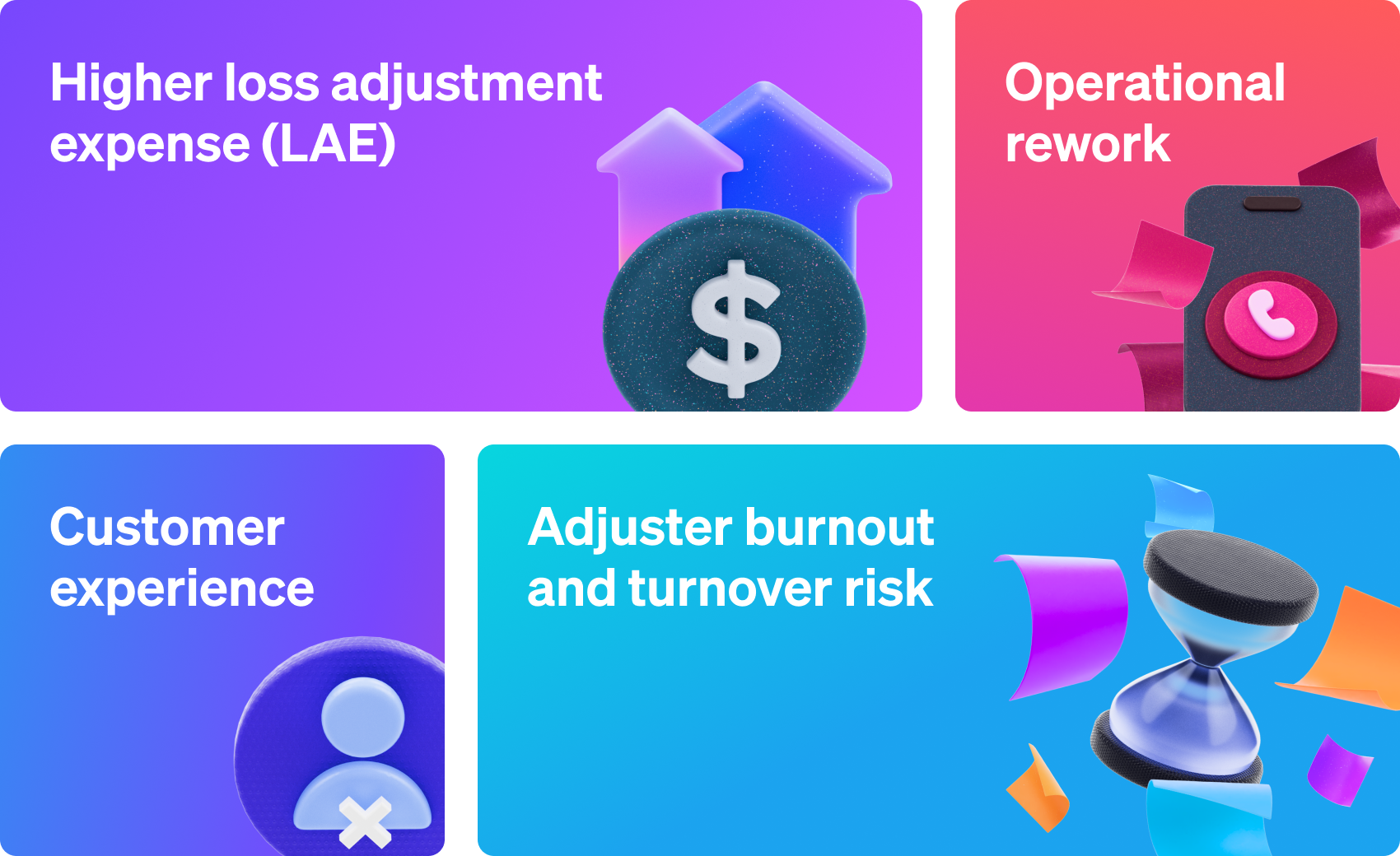
- Higher loss adjustment expense (LAE): Longer cycle times increase costs as rework accumulates and claims require more touchpoints.
- Operational rework: Inconsistent intake and documentation lead to repeated follow-ups.
- Degraded customer experience: Messy processes lead to more back-and-forth communication, which drags out cycle time and lowers Net Promoter Score (NPS).
- Adjuster burnout and turnover risk: Administrative work crowds out judgment-driven tasks, overloading adjusters and increasing attrition risk.
Claims leaders are also operating under increasing pressure as volumes continue to rise without proportional increases in budget or staffing. Claims are more complex, involving multiple exposures and third parties. Policyholders expect real-time updates across digital channels, not phone tag. At the same time, regulatory and audit requirements demand clear, consistent documentation. All of this makes it more important than ever for carriers to prioritize efficient claims management.
How modern claims management software addresses common challenges
Modern claims management software addresses operational challenges by creating a strong automation foundation that results in fewer handoffs and more accurate decisions. It all starts with collecting structured data at first notice of loss.
From here, AI-powered solutions can automate communication and downstream work, reducing handoffs and shortening cycle times. When claims management is designed to support automation from the start, carriers reduce loss adjustment expense and improve how adjusters work and how customers experience the claims process.
The claims management process: Step-by-step overview
In insurance claims management software, workflows vary by carrier, line of business, and jurisdiction. However, the core claims management process follows a consistent path. Most claims move from intake through resolution in a series of defined stages, each dependent on the quality of information captured earlier.
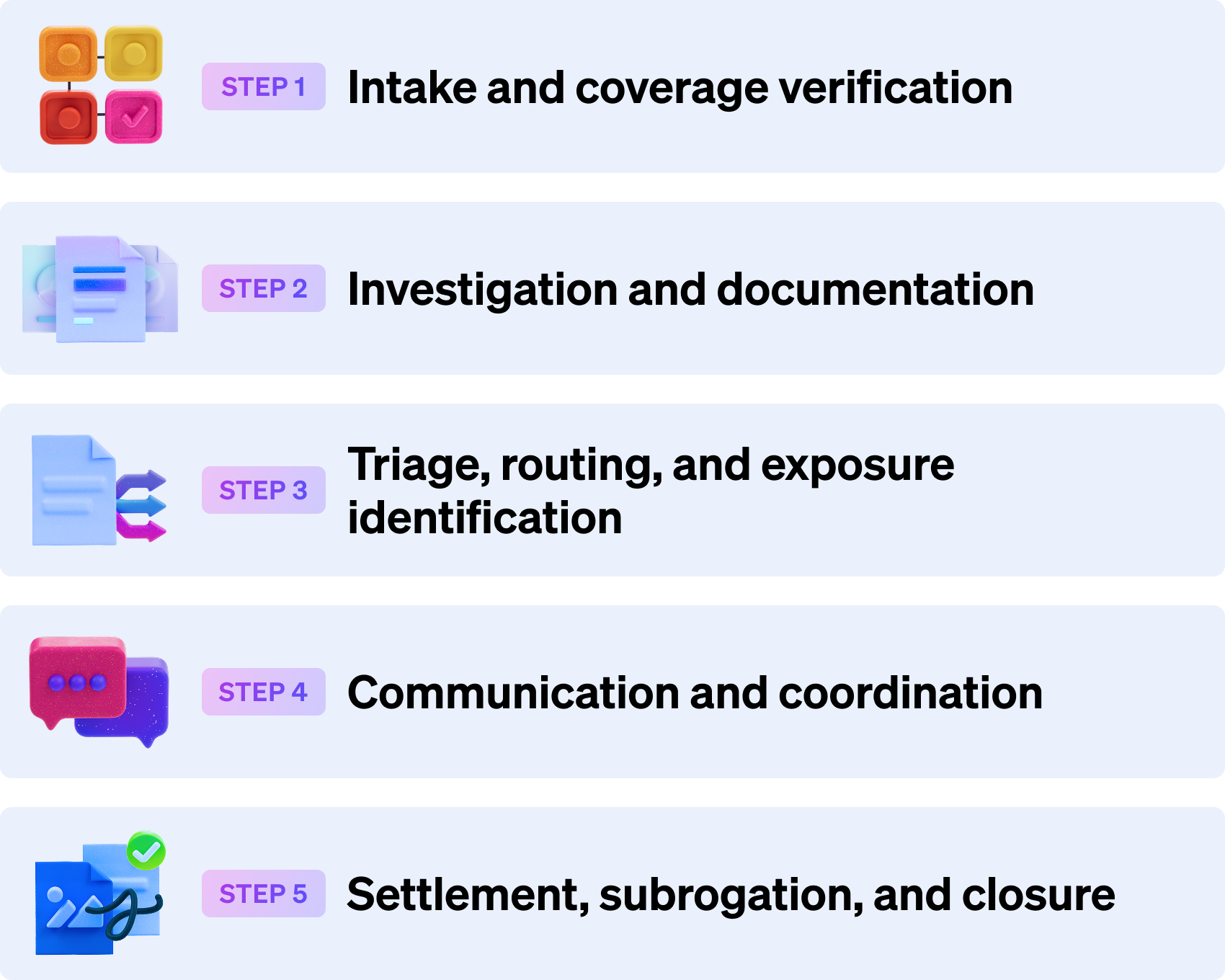
Step 1: Intake and coverage verification
Claims begin at FNOL, and this step establishes the data foundation and overall efficiency for the entire claim. When digital claims intake workflows capture quality data, both through self-service solutions and structured call center intake, coverage can be validated earlier and more accurately. Additionally, digital First Contact solutions help streamline outreach to involved parties. This reduces follow-up questions and shortens overall cycle time.
Step 2: Investigation and documentation
During investigation, adjusters collect statements, photos, documents, and repair estimates. When these inputs arrive as unstructured PDFs or free-text notes, decision-making slows and inconsistencies increase.
Claims management systems that collect structured data from the start of a claim improve investigation accuracy and surface discrepancies earlier. These systems also reduce back-and-forth with claimants and vendors.
Step 3: Triage, routing, and exposure identification
Effective claims management assigns claims based on severity, complexity, and exposure. Automation reduces routing errors and ensures claims reach the right adjuster quickly, supporting faster and more consistent outcomes.
In addition, solutions with early fraud detection embedded allow carriers to identify suspicious patterns before claims move too far downstream, reducing rework, unnecessary handoffs, and avoidable cycle time inflation.
Step 4: Communication and coordination
Communication is one of the largest drivers of both customer satisfaction and adjuster workload. Omnichannel communication solutions reduce inbound calls while keeping all parties informed and on the same page. Agentic AI assistants can further reduce adjuster workload by independently handling routine updates, information requests, and follow-ups. The same workflow can also extend to automated service assignment, helping carriers coordinate inspections, repairs, rentals, and other downstream services without adding manual work for adjusters.
Step 5: Settlement, subrogation, and closure
Structured documentation supports accurate valuation and defensible settlement decisions. Automated reminders prevent claims from stalling. Clear audit trails support compliance and simplify post-closure review. Together, these steps form a claims management system that prioritizes speed, consistency, and auditability across the full lifecycle.
Claims management solutions: What today’s insurance leaders need
Modern claims management solutions are designed to help carriers scale operations without adding headcount or disrupting existing systems. These claims management solutions allow carriers to handle higher volume, greater complexity, and rising customer expectations with the same or fewer resources.
Insurance leaders consistently look for the same core capabilities in a claims management system:
- FNOL that captures structured data from the start of a claim, eliminating manual re-entry and reducing downstream rework
- Automated triage and routing to assign claims based on severity, exposure, and complexity
- Omnichannel communication to keep claims moving without increasing inbound calls
- AI-driven follow-ups to prevent stalled claims and missed tasks
- Support for multi-exposure claims without custom workflows
- Proactive, intelligent CAT solutions to handle surge volume, coordinate tasks, and maintain consistency during catastrophe events
- Real-time visibility into cycle time, workload, and bottlenecks
Legacy systems struggle to deliver these outcomes. They rely on inconsistent case notes, manual handoffs, and rigid configurations that slow change. Automation layered on top of unstructured data rarely scales.
Assured approaches claims management by fixing the root problem: quality data from the start of every claim.
The platform captures structured, machine-readable data at first notice of loss, which unlocks downstream automation and straight-through processing across the claims lifecycle.
Assured works alongside existing core systems, allowing carriers to prove value without rip-and-replace or heavy integrations. API-first architecture and modular solutions enable carriers to deploy quickly with minimal IT investment to see value one claim at a time.
How claims management software drives efficiency and better outcomes
Claims management software delivers measurable efficiency by reducing manual work and improving decision quality across the claims lifecycle. This is achievable with modern claims management software that is designed around structured data and automation. AI-powered capabilities are built into the core workflow, rather than layered on top of broken processes.
Structured data captured at first notice of loss reduces rework and enables automation downstream. Intelligent routing assigns claims based on severity and exposure, minimizing handoffs. Automated communications and follow-ups prevent stalled claims and reduce inbound call volume.
Together, these capabilities allow adjusters to focus on evaluation and resolution rather than administrative tasks.
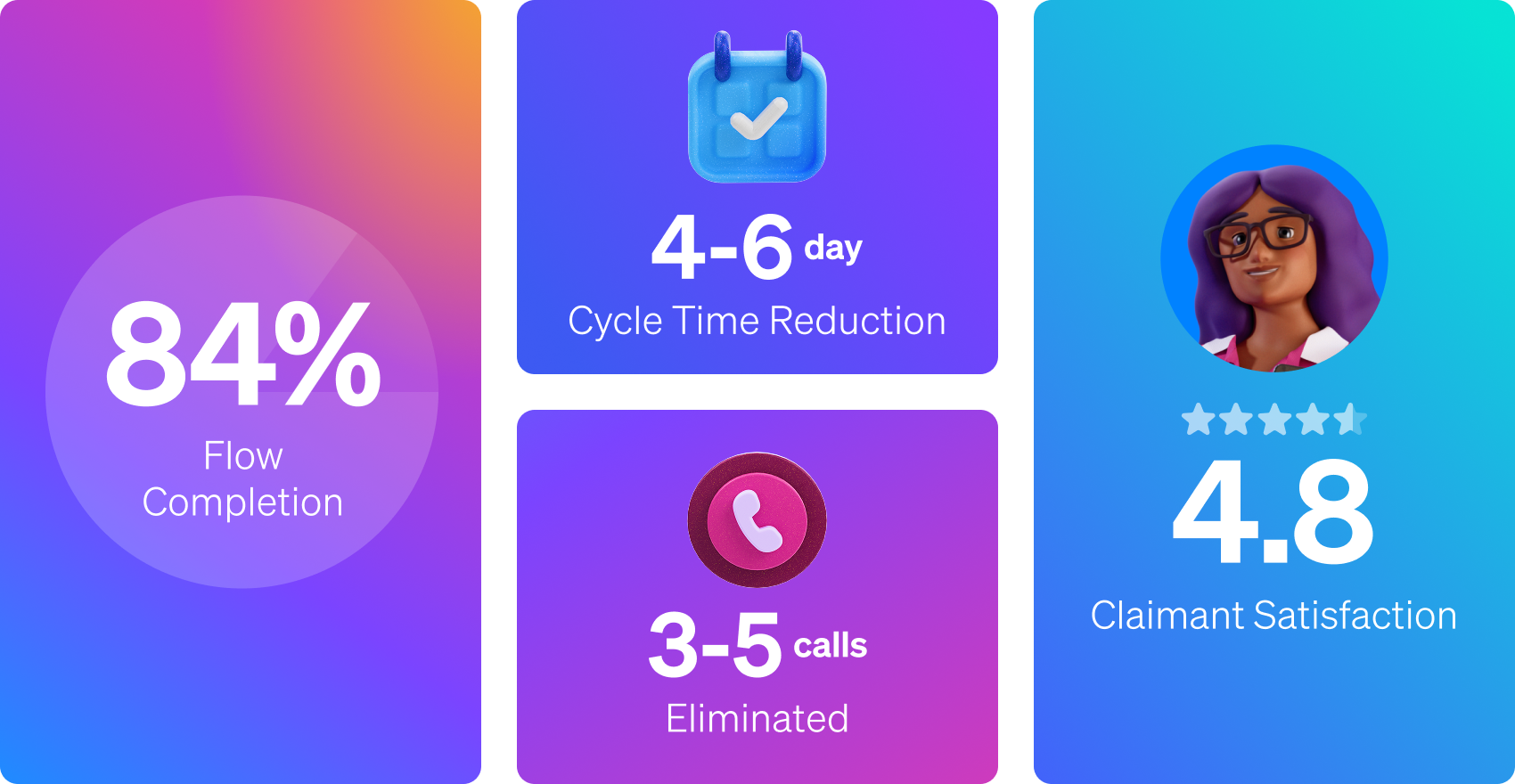
Carriers using Assured see results like:
- 4-6 day reductions in cycle time, translating to ~$119 savings per claim
- 3-5 fewer phone calls per claim
- 4.8/5 customer satisfaction, as a result of faster, more intuitive digital experiences
How AI improves claims management
Leading carriers are approaching claims automation in different ways. They focus on fixing the data AI depends on, rather than adding more tools. Assured captures structured, machine-readable data from the first interaction, giving AI a solid foundation to interpret context and execute the Next Best Action automatically.
For Chief Claims Officers, the impact is faster cycle times and lower LAE. For Claims Operations leaders, it’s higher throughput without additional headcount. For Innovation leaders, it’s rapid deployment and compatibility with existing systems. All of it depends on one foundation: collecting structured data at FNOL and pairing it with AI-powered solutions that enable true straight-through processing.
See how modern claims management transforms the entire claims lifecycle
Strong claims management produces repeatable outcomes: faster cycle times, fewer handoffs, consistent documentation, lower LAE, and higher customer satisfaction. Starting with structured data lets carriers achieve true AI-powered automation from FNOL through settlement.
Assured provides a modular claims automation platform with solutions that support the full claims lifecycle. Structured, machine-readable data collected at FNOL powers everything downstream, from intelligent routing to automated communication and defensible settlement decisions. Each solution works independently or together, integrating with existing core systems to standardize intake, automate workflows, and enable straight-through processing.
For insurance leaders evaluating claims management, the priority is delivering modernization that produces meaningful results quickly.
Book a 30-minute demo with a claims automation expert to learn more about the Assured platform.
Last modified on October 6, 2026

Subscribe for updates
You might also like
FNOL automation: How AI is transforming claims intake
Learn how AI-powered FNOL automation helps carriers reduce cycle time and improve accuracy.
By The Assured Team


Subscribe for updates
By providing your email, you indicate you have read and understood our Privacy Policy.