

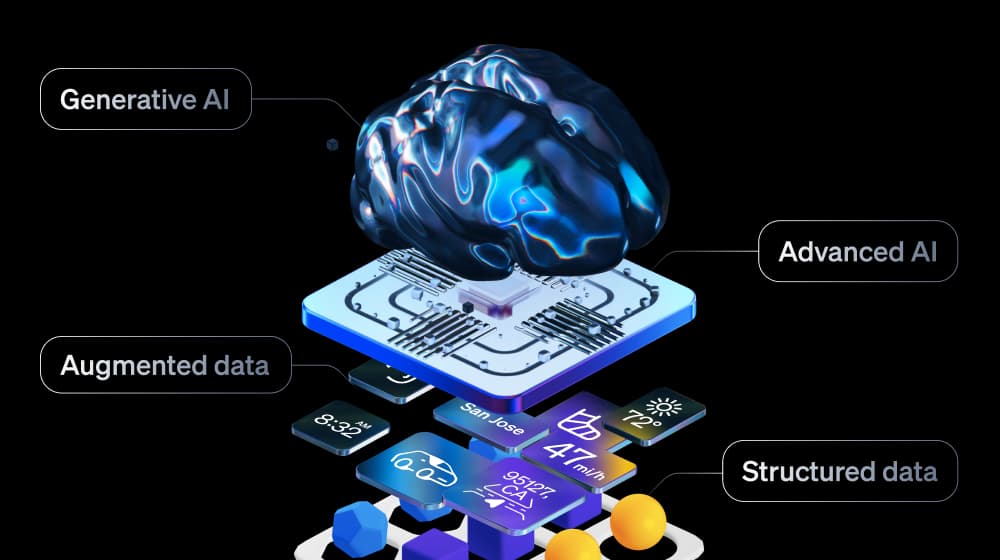




Claims automation has entered a new phase. Using AI in insurance claims is unlocking powerful automation opportunities. However, AI is only as good as the data you feed it. Carriers require a foundation of quality data to achieve true automation.
Assured’s AI-powered claims automation combines world-class AI with the industry’s highest-quality data to achieve what others couldn’t: Straight-through processing at enterprise scale. From FNOL to liability decisioning, Assured’s solutions offer carriers meaningful claims automation at every stage of the claims lifecycle.
This guide explores what claims automation is, how Assured helps carriers use AI to achieve straight-through processing, and what types of automation can make a meaningful difference for your claims organization.




Assured: The leading AI platform in P&C
Trusted by the nation’s top insurers, Assured processes tens of millions of claims each year, delivering straight-through processing at enterprise scale.
Learn moreWhat is claims automation?
Claims automation refers to the use of AI automation to reduce manual steps across the claims lifecycle. Automation enables faster decision making and greater accuracy while enhancing the customer experience and increasing operational consistency across high-volume claims workflows. Claims automation streamlines or fully removes repetitive tasks that slow claims teams down. These tasks include data capture, verification, documentation, communication, and routing.
Automation ensures information moves cleanly and consistently between systems and stakeholders, instead of relying on manual reentry, phone calls, and follow-ups. Insurance claims automation replaces fragmented workflows with coordinated, rules-driven processes that scale with volume. These are a few of the ways that automation works within the claims lifecycle:
- Workflow automation: Workflow automation manages task sequencing and handoffs between systems so claims progress without manual coordination.
- Data automation: Data automation extracts, validates, and structures information from forms, emails, documents, and images into machine-readable formats that downstream systems can reliably use.
- Automated triage and eligibility checks: AI-supported communication guides policyholders through intake, requests missing documentation, handles follow-ups, and responds to user questions.
- Straight-through processing: Automated triage and eligibility checks route claims to appropriate teams based on severity, coverage, and complexity.
For straightforward, low-risk claims, automation can enable straight-through processing. Claims move from first notice of loss (FNOL) to resolution with little or no human intervention.
In insurance, claims automation requires structured, machine-readable data to work. When claims begin with quality data, downstream systems can reliably trigger appropriate workflows and execute next steps with minimal human oversight.
AI for claims processing leverages this structured foundation to power intelligent decision-making.
Does claims automation replace adjusters?
A common misconception is that automation eliminates the need for adjusters. In reality, automation streamlines repetitive, monotonous tasks that slow adjusters down. By handling administrative overhead, automation frees adjusters to focus on nuanced judgment calls, complex investigations, and policyholder relationships that require empathy and expertise.
Adjusters are able to prioritize high-value work that challenges them, improving retention and employee happiness. The result is a more efficient and scalable claims operation across the board.
Why claims automation matters for P&C carriers
Claims automation directly supports insurer goals around efficiency, cost control, cycle time improvement, customer experience, and regulatory compliance. At the executive level, claims automation ties directly to the metrics that matter most:
- Cycle time
- Loss adjustment expense (LAE)
- Net Promoter Score (NPS)
- Adjuster productivity
As claims organizations are asked to do more with less, automation becomes a core operational lever rather than a future aspiration. Customer expectations rise quickly, and policyholders now expect claims interactions to be intuitive and digital-first, with proactive updates and clear next steps.
Delays, repeated requests for the same information, or inconsistent communication erode trust. Claims automation helps meet these expectations by standardizing how information is collected, processed, and communicated. Automation reduces uncertainty for both customers and internal teams.
At the same time, operational pressures continue to mount. Claim volumes are rising, claim complexity is increasing, and experienced adjusters are becoming harder to hire and retain. Documentation requirements also continue to expand, while many carriers still operate across fragmented systems that were not designed to work together.
Without automation, adjusters spend a disproportionate amount of time on manual data entry, document chasing, and status updates instead of evaluating coverage, assessing liability, and resolving claims.
How claims automation addresses these challenges
Claims automation addresses rising claim volumes, increasing complexity, and staffing constraints by enforcing consistent processes across claim types and lines of business. Automated claims processing also reduces manual workload across claim types. By standardizing intake, communication, and documentation workflows, automation minimizes variance between adjusters and ensures consistency across the organization. The result is improved accuracy, supported compliance, and reduced likelihood of missed steps or overlooked details.
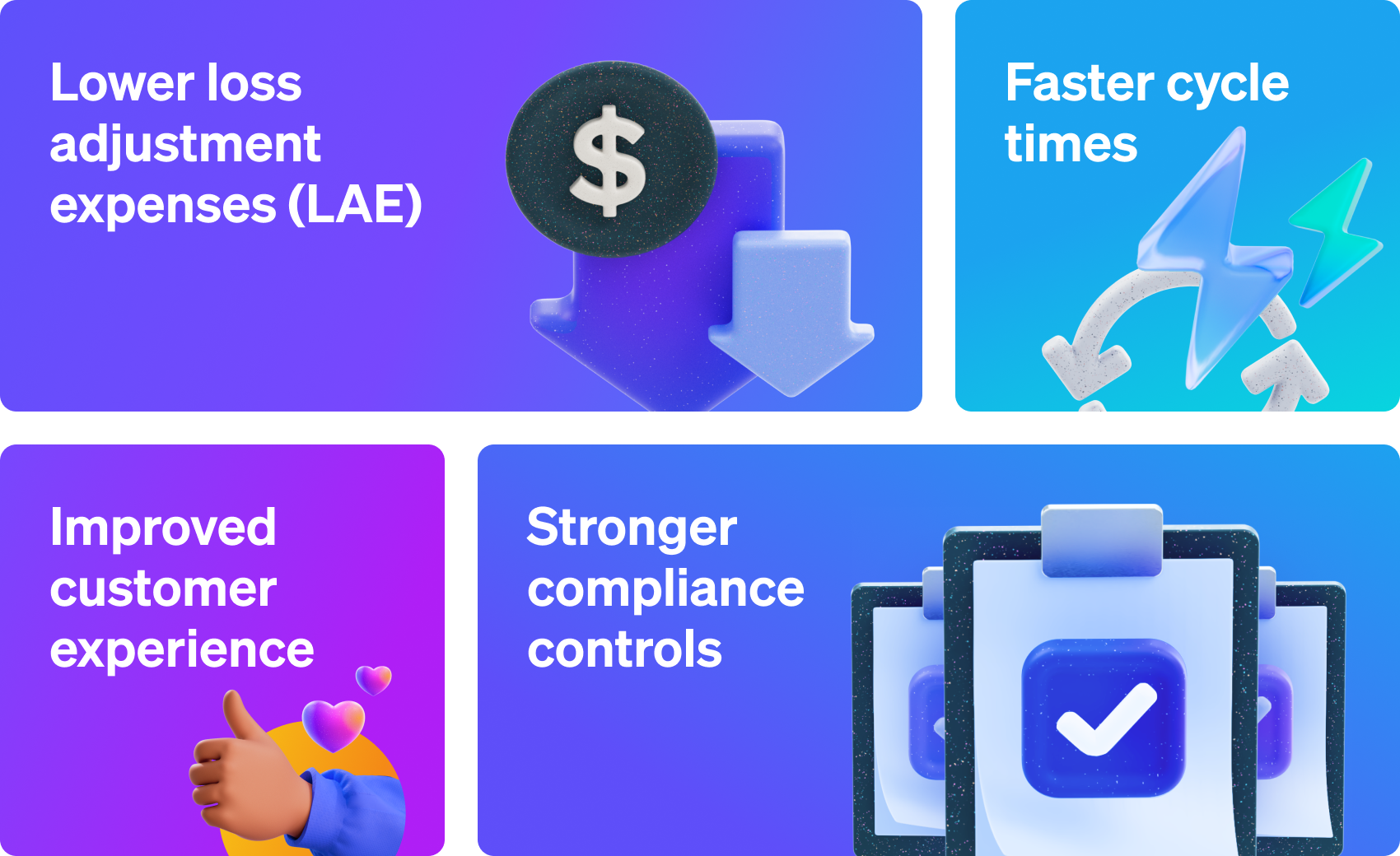
The impact of automated claims processing is measurable:
- Lower loss adjustment expenses (LAE): Automation reduces administrative effort and limits rework across the claims process.
- Faster cycle times: Removing manual coordination helps eliminate bottlenecks and move claims forward more efficiently.
- Improved customer experience: Faster responses and more predictable interactions contribute to higher NPS.
- Stronger compliance controls: Standardized documentation and consistent decision logic create audit-ready records across every claim.
Scalability is one of automation's most significant advantages. During catastrophe events or seasonal claim spikes, traditional operations require additional headcount to maintain service levels. Claims automation lets carriers scale as needed without requiring additional staff.
How claims automation works across the claims lifecycle
Automation operates across every stage of the claims processing lifecycle. The sections below outline how automation supports each stage of the process, from FNOL through final settlement.
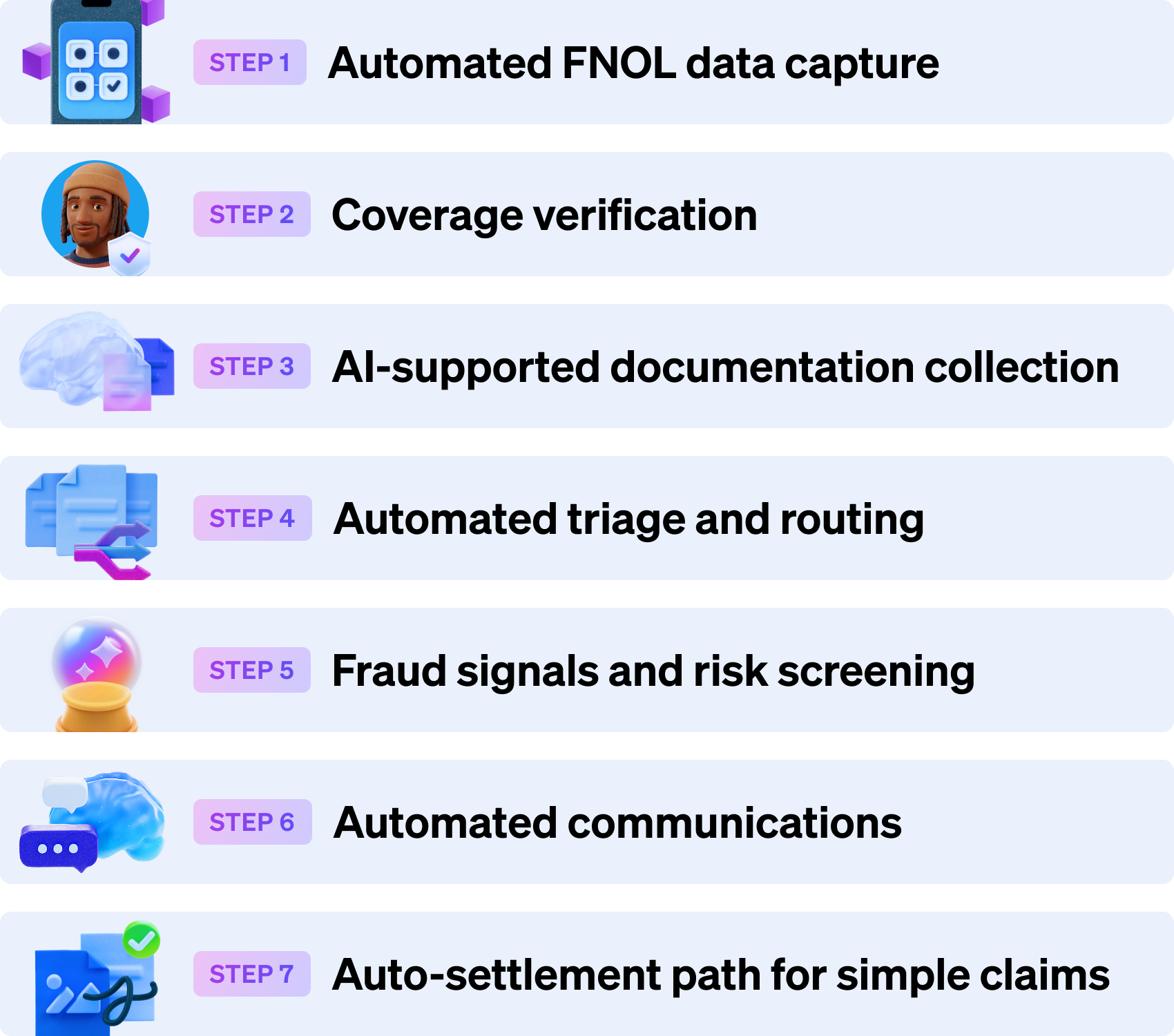
Step 1: Automated FNOL data capture
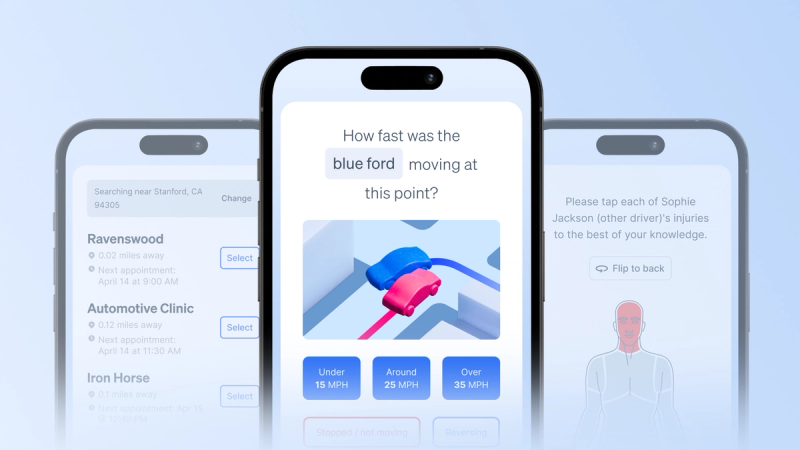
Structured data and Assured’s digital claims intake workflows reduce missing information by guiding policyholders through intelligent question flows. Dynamic intake adapts in real time based on claim type, loss details, and policy coverage, ensuring all required fields are captured before the claim progresses. Validation logic checks data completeness and accuracy at the point of entry, flagging inconsistencies or gaps.
Step 2: Coverage verification and eligibility checks
Automated checks confirm policy status, deductibles, coverage limits, and exclusions. Systems cross-reference claim details against policy terms and flag any coverage questions or eligibility issues. During initial outreach, digital First Contact detects when information is missing or ambiguous, automation triggers prompts to collect clarifying details, preventing claims from moving forward with incomplete information.
Step 3: AI-supported documentation collection
One of the most time-consuming parts of claims is collecting documentation. Adjusters spend hours requesting and waiting for additional evidence and photos. Agentic AI assistants can automate much of this process, requesting documents and guiding customers through submission processes to ensure adjusters have everything they need.
Emma, which is Assured’s agentic AI, autonomously handles ~70% of customer interactions. Emma proactively collects missing documentation like receipts and photos, verifies information, and performs tasks like clarifying claim details. This automation keeps claims moving forward without manual adjuster involvement.
Step 4: Automated triage and routing
Claims processing automation analyzes claim type, severity, complexity, and jurisdiction to route claims accurately. High-severity or high-complexity claims escalate to experienced adjusters, while routine claims progress through automated workflows. For simple, low-risk claims, straight-through processing enables touchless resolution without manual review.
Step 5: Fraud signals and risk screening
Assured’s AI-powered fraud detection flags suspicious patterns early in the lifecycle, enabling adjusters to investigate high-risk claims while low-risk claims proceed without delay. Studies show that automation improves claim validation time by 70% and catches 95% of fraud cases. Automated risk screening analyzes historical patterns, policy details, and external data sources to surface potential fraud signals and support informed decision-making.
Step 6: Automated communications
Managing ongoing claim communication across channels is a major challenge for adjusters. Assured’s omnichannel messaging solution consolidates all claim-related communication from SMS, email, and chat into one structured thread. Policyholders receive proactive status updates and guidance through their preferred channels, while adjusters can view all claim-related communication in one centralized place.
Additionally, Assured’s automated service assignment solution makes it easy for claimants to self-schedule repairs, rentals, tows, and more, cutting down on back-and-forth scheduling that can slow claims down.
Step 7: Auto-settlement path for simple claims
Certain low-severity claims may proceed through straight-through processing, with automated workflows handling verification, documentation review, payment calculation, and settlement without manual intervention. This reduces cycle time, lowers costs, and delivers exceptional policyholder experiences for straightforward claims.
AI use cases in claims automation
In insurance claims processing, AI enables deeper automation across the claims lifecycle. By automating routine tasks and surfacing the right information at the right moment, AI allows adjusters to focus on judgment calls that actually require human expertise. It does not replace people. It makes them more effective.
The impact is tangible. Bain & Company estimates AI can reduce loss adjustment expenses by up to 25% and cut leakage by as much as 50%, unlocking more than $100 billion in value across insurers and customers.
The real shift shows up in the customer experience. Faster decisions and clearer updates reduce status checks and prevent repeated requests. Proactive follow-ups remove uncertainty and keep claims moving forward. Confidence builds as friction fades.
Practical AI use cases
AI stops being a backend efficiency play and becomes a front-line differentiator as digital experience becomes a primary driver of loyalty. The question for insurers is no longer whether to use AI, but where to start. The highest-impact use is clear. Automate the repetitive, standardize the complex, and keep humans focused on exceptions and judgment.
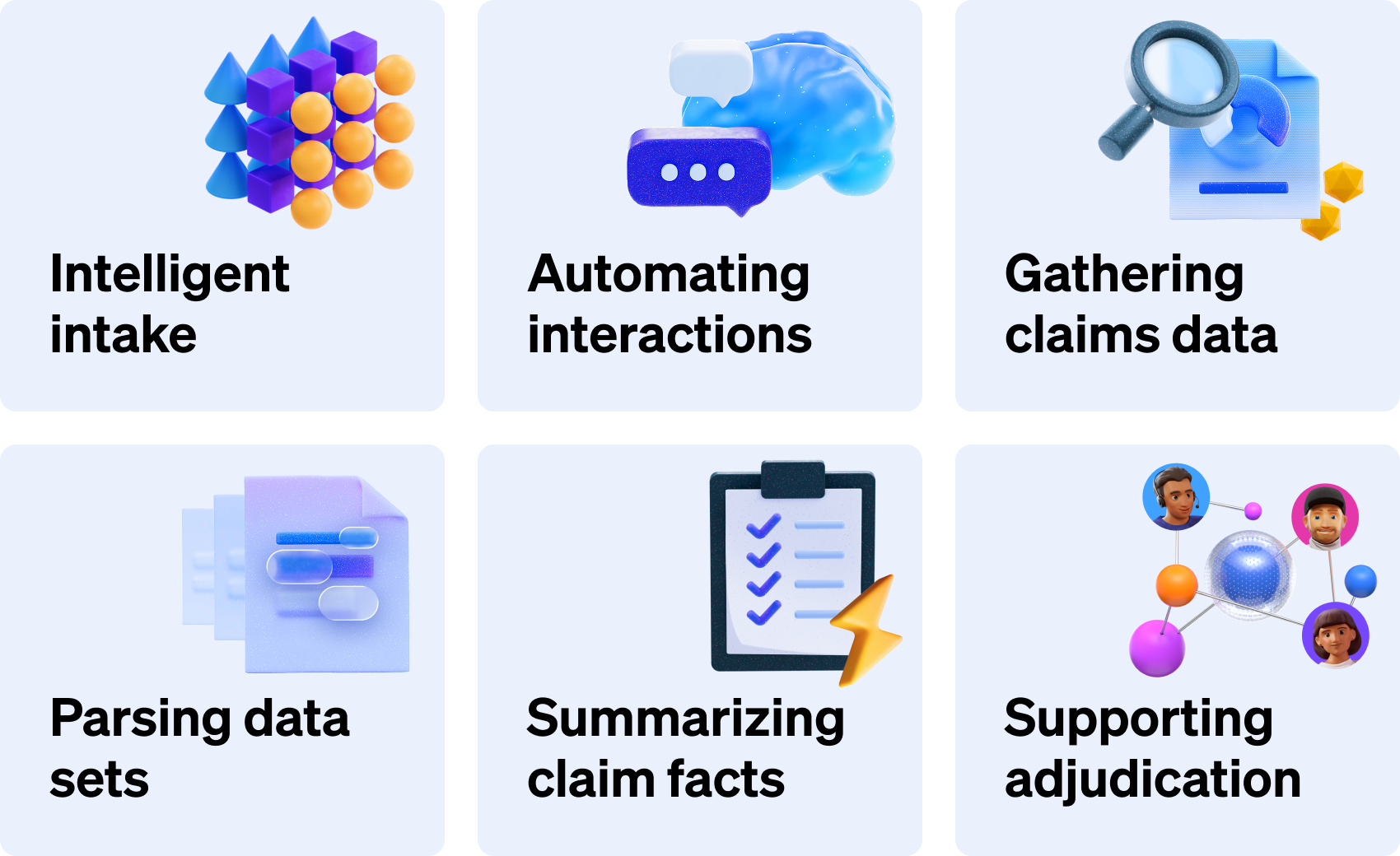
Delivering intelligent intake
AI can dramatically simplify the intake process for customers while producing higher-quality data for adjusters. Dynamic question flows adapt based on policyholder responses and claim details. Document extraction and classification automatically parse repair estimates, medical records, and demand letters, extracting key data points and routing documents to appropriate teams. Information validation cross-references policyholder statements against external data sources, flagging inconsistencies and triggering follow-up questions when needed.
Automating adjuster-claimant interactions
AI can be used to request missing documents, resolve inconsistencies, and deliver real-time updates automatically. The result is less back-and-forth and more time for adjusters to focus on decisions that matter.
Gathering the long-tail of claims data
AI surfaces the small but critical details that often delay resolution. Vehicle locations, witness statements, repair approvals, and edge-case inputs are captured across channels. This closes gaps early and ensures consistency from the start.
Ingesting and parsing large data sets
From medical records to legal demand letters, AI extracts key facts, categorizes content, and structures data automatically. Unstructured documents become usable inputs without manual review.
Summarizing claim facts for subrogation and litigation
AI distills complex claim histories into clear, defensible summaries. Timelines, evidence, and findings are presented in consistent, audit-ready formats that support faster legal and subrogation workflows.
Supporting adjudication decision-making
With structured data and context in place, AI supports liability evaluation, coverage checks, and fraud detection. It does not replace adjusters. It ensures decisions are faster, more consistent, and based on complete information.
Business impact: How automation improves performance across the claims lifecycle
Claims automation drives measurable impact across cycle time, adjuster capacity, loss adjustment expenses, customer experience, and compliance. Modern automation delivers concrete operational improvements that directly affect carrier profitability and policyholder satisfaction.
Faster cycle times result from fewer handoffs and less rework. There are also far fewer bottlenecks when claims begin with complete, structured data and progress through automated workflows. Adjusters spend less time chasing missing information, reconciling data across systems, or waiting for manual approvals. Claims that once took weeks can close in days, improving policyholder satisfaction and reducing exposure to fraud and escalation.
Improved adjuster capacity emerges from reduced administrative overhead. Automated insurance systems handle routine tasks, allowing adjusters to manage larger caseloads without sacrificing quality.
Lower loss adjustment expenses follow from fewer manual steps and more efficient workflows. When automation handles intake, verification, documentation, and triage, carriers reduce the labor hours required per claim. Consistency across adjusters and claim types minimizes errors and rework, further lowering costs. During catastrophe surge conditions, automation enables carriers to scale operations without proportional increases in staffing.
More consistent documentation supports regulatory compliance and defensible outcomes. Automation creates comprehensive audit trails, standardizes communication templates, and ensures all required steps are completed before claims advance. This reduces compliance risk and improves the defensibility of settlement decisions.
Better customer experience emerges from faster responses and clearer communication. Automation provides proactive updates, eliminates hold times, and gives policyholders visibility into claim status. Satisfaction scores rise, and retention improves when policyholders receive instant responses to routine questions and clear guidance on next steps.
Automation represents a scalability multiplier. Claims surge during catastrophe events, and automated, proactive CAT solutions maintain consistent service levels without requiring proportional resource increases. This fundamental advantage positions automation as a strategic imperative for carriers navigating capacity constraints and rising customer expectations.
Challenges and considerations in claims automation
Claims automation requires strong foundations, thoughtful design, and operational readiness. While the benefits are substantial, carriers must navigate several considerations to ensure successful implementation and sustainable results.
Data quality represents the most critical consideration. Automation built on unstructured or incomplete data produces unreliable results. Downstream automation fails when claims begin with open-ended inputs, inconsistent formats, or missing details. Structured data captured at FNOL creates the foundation for reliable automation, enabling accurate triage, consistent workflows, and defensible decisions.
Complex workflows needing expert judgment present another consideration. Not all claims are candidates for full automation. High-severity losses, contested liability, fraud investigations, and nuanced coverage questions require adjuster expertise. In insurance claims, AI recognizes these boundaries and escalates appropriately while handling routine aspects autonomously.
How to apply claims automation within legacy systems
Integration across legacy systems can create implementation friction. Many carriers operate fragmented technology environments with limited interoperability. Modular, API-first automation platforms reduce integration complexity by wrapping around existing systems rather than requiring wholesale replacement. This holistic approach enables carriers to modernize incrementally, adding automation where it delivers the greatest value without disrupting core operations.
Regulatory compliance requires careful attention to audit trails, explainability, and defensible decision-making. Automation systems must produce transparent documentation. Systems must show how decisions were reached, what data informed outcomes, and when human oversight occurred. This transparency ensures regulatory compliance and supports defensibility in contested claims.
Change management and adjuster adoption affect automation success. Adoption accelerates when adjusters understand how automation supports their work. Effective implementations emphasize augmentation over replacement, demonstrating how automation removes administrative burden while empowering adjusters to focus on higher-value activities.
How insurers can successfully adopt claims automation
Successful claims automation adoption requires clear goals, structured data, phased rollout, and alignment across claims, IT, and customer experience teams. The following strategies help carriers maximize automation benefits while minimizing implementation risks.
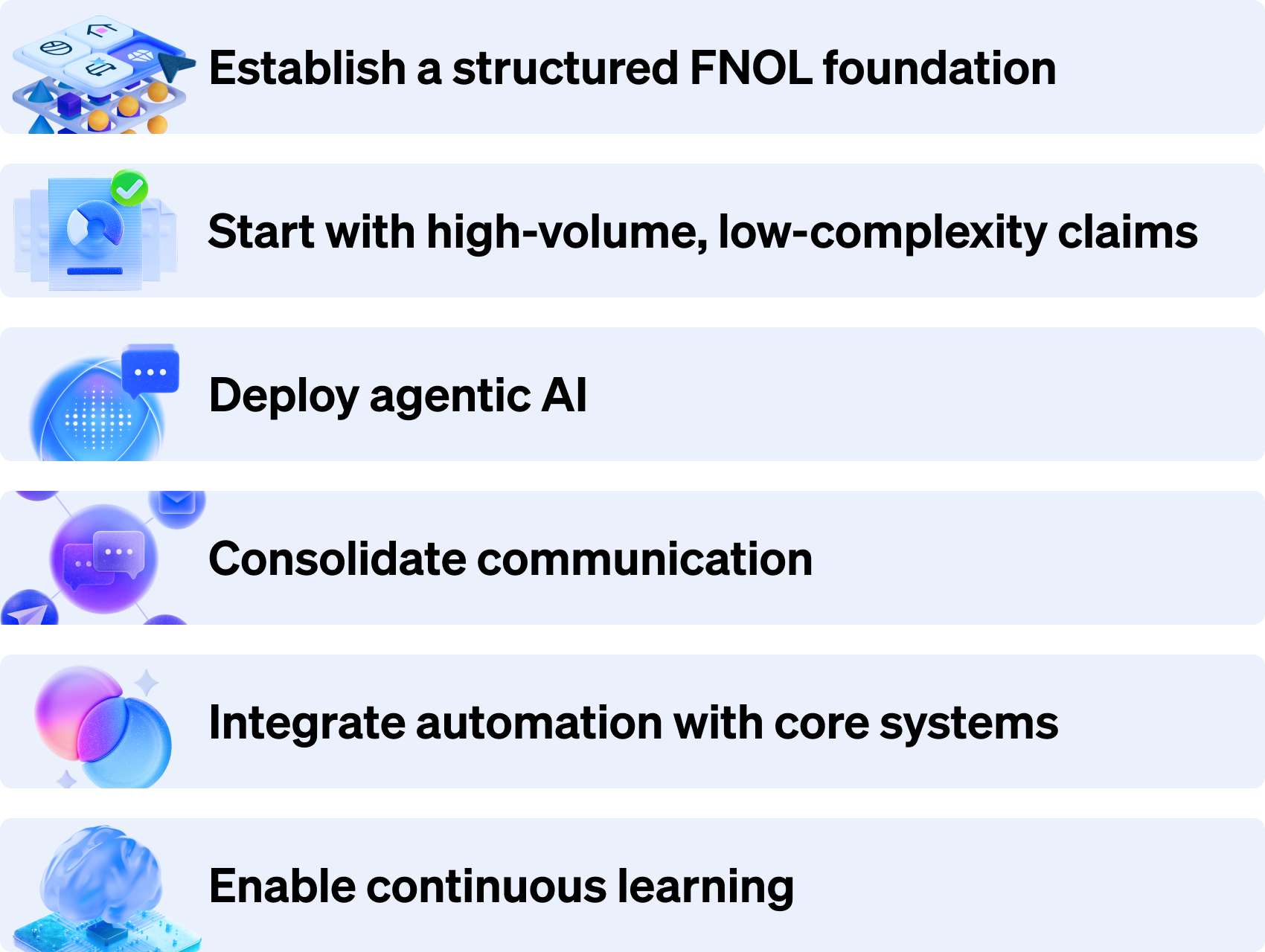
Strategy 1: Establish a structured FNOL foundation
Structured FNOL intake is essential for reliable downstream automation. When claims begin with complete, machine-readable data, every subsequent workflow benefits. Digital FNOL solutions and their call center equivalents capture clean inputs through intelligent question flows, dynamic validation, and real-time data enrichment. This foundation enables accurate triage, consistent processing, and reliable straight-through processing for low-complexity claims.
Strategy 2: Start with high-volume, low-complexity claims
Build momentum where automation yields the fastest benefits. Simple property damage claims, glass-only auto claims, and other high-volume, low-complexity claim types offer immediate opportunities for straight-through processing. Early wins demonstrate value, build stakeholder confidence, and generate operational learnings that inform broader rollout.
Strategy 3: Deploy agentic AI for communication and data collection
Emma increases data completeness and reduces inbound call volume by handling routine inquiries and proactively collecting missing information. Emma operates 24/7, providing instant responses and keeping claims moving forward without adjuster intervention. When situations require human judgment, Emma escalates seamlessly, ensuring the right cases reach adjusters at the right time.
Strategy 4: Consolidate communication for transparency and efficiency
Unified communication threads eliminate delays across channels. When all claim-related messages—incoming and outgoing, across SMS, email, and web—appear in one structured view, adjusters gain complete context without searching across systems. Policyholders receive consistent, transparent communication regardless of channel.
Strategy 5: Integrate automation with core systems
Automation should fit into your existing environment. Automated insurance claims processing platforms built with modern architectures connect easily to claims management systems, allowing carriers to pilot solutions. This reduces implementation friction and enables carriers to add automation incrementally without requiring full system replacement.
The best claims automation solutions let you pilot before you commit. A well-structured pilot should require minimal IT effort and be easy to test, with no heavy integrations required. The solutions should integrate seamlessly into existing workflows so teams can test with zero disruption. And most importantly, look for partners who offer pilots that deliver fast, measurable results. The goal is to have clear comparison data quickly, with no guesswork.
Strategy 6: Enable continuous learning and feedback loops
Supervisors refine workflows, routing logic, and automation thresholds based on operational feedback. Continuous improvement ensures automation adapts to changing claim patterns, regulatory requirements, and business priorities. Regular review of automation performance (including cycle times, accuracy, and policyholder satisfaction) guides optimization and identifies expansion opportunities.
Future of claims automation: What's next for P&C operations
As claims processing automation matures, carriers will gain access to increasingly sophisticated capabilities that further reduce manual intervention and improve outcomes.
More advanced triage logic will enable dynamic routing based on real-time risk assessment. Documentation needs are predicted in real time, anticipating required evidence before an adjuster ever asks for it. Systems proactively collect photos, statements, and supporting records that accelerate resolution and reduce back-and-forth. Subrogation opportunities surface early in the lifecycle, identifying recovery potential while facts are fresh and improving recovery rates while reducing leakage.
Fraud detection is also operating at a broader, more sophisticated level. Intelligent fraud pattern detection leverages larger data sets and advanced models to identify coordinated fraud schemes, organized rings, and emerging behaviors as they form. Instead of flagging individual claims in isolation, modern systems detect connections across the following:
- Policyholders
- Service providers
- Locations
- Historical claim patterns
This network-level visibility allows carriers to address fraud more comprehensively and intervene earlier, before losses compound.
Customer expectations are driving this shift. Digital experiences are no longer differentiators, but baseline requirements. Policyholders expect instant responses, proactive updates, and clear visibility into what happens next.
From AI tools to orchestrated claims workflows
The future of claims transcends adding more tools. AI’s future is about systems that can actually automate work. AI in claims only becomes valuable when it understands the domain and has structured data to operate on. The real shift is moving from isolated point solutions to integrated automation that handles complexity, assembles evidence, and accelerates decisions across the lifecycle.
That shift starts with structured intake. Downstream automation becomes possible and reliable when claims start as clean, machine-readable data instead of transcripts and scanned paperwork. This is where cycle time compresses, variability drops, and claimant experience improves without increasing human load.
AI’s role is no longer theoretical. In production today, AI guides claimants through intake, collects evidence proactively, clarifies inconsistencies before they escalate, summarizes complex information for review, and delivers high-confidence liability and coverage decisions to adjusters. The workflow itself becomes orchestrated rather than manually stitched together.
Automation compounds over time. Better data enables better automation, better automation improves data quality, and improved data quality drives better operational and customer outcomes.
Insurers investing in automation now are meeting today’s expectations while building operational advantages that compound over time, improving efficiency, resilience, and customer trust across every stage of the claims lifecycle.
Modular automation replaces monolithic claims transformations
Platforms are switching to modular solutions built to work with legacy systems. Instead of committing to multi-year transformations upfront, carriers deploy individual modules alongside existing core systems to prove value on real claims first.
These modules integrate directly with current infrastructure rather than replacing it, allowing teams to test impact, validate outcomes, and build internal confidence without operational disruption.
This incremental approach accelerates innovation while significantly lowering implementation risk. Carriers can measure cycle time reduction, workload savings, and customer experience improvements in production before expanding adoption.
Successful modules are scaled. Underperforming ones are adjusted or swapped out.
The result is faster learning, tighter alignment to business goals, and the ability to modernize claims operations without betting everything on a single, monolithic rollout.
See how modern claims automation transforms P&C operations
Claims automation accelerates settlement and improves adjuster capacity across every line of business. It also enhances the policyholder experience through faster, more predictable outcomes. Assured’s Claims Intelligence Platform is already proving it in production.
Carriers using Assured typically see:
- 4-6 day reductions in cycle time
- 3-5 fewer phone calls per claim
- 4.8/5 claimant satisfaction scores.
FNOL is where these gains begin. Assured’s digital FNOL solution drives 84% flow completion, roughly three times the industry average. Structured data at intake enables downstream automation that would be impossible from call center transcripts alone.
By starting with structured data and layering intelligent automation across FNOL, communication, triage, and settlement, Assured enables carriers to achieve true straight-through processing.
Emma handles 70% of interactions autonomously, freeing adjusters to focus on complex decisions.
Assured Messaging consolidates communication across channels, eliminating delays and improving transparency. Modular components work independently or together, fitting around your existing systems and delivering value from day one.
Book a 30-minute demo with a claims automation expert.
Last modified on August 25, 2026

Subscribe for updates
You might also like

The FNOL process: A step-by-step breakdown
Understand the FNOL process and learn how structured data improves accuracy, speed, and automation.
By The Assured Team

Subscribe for updates
By providing your email, you indicate you have read and understood our Privacy Policy.