





Policyholders expect their claims to be resolved in 11 days, but the industry average for claims cycle time is 23.9 days. Digital-first carriers, however, close claims in just 15 days.
That 13-day difference between expectation and delivery is exactly where you can pull ahead. Carriers investing in structured data and smart automation are already resolving claims faster while building the policyholder experience that earns renewals.
Assured’s platform enables measurable improvements in speed, cost, and customer satisfaction by modernizing claims automation with structured data and AI-driven solutions. This article covers what drives claims cycle time in insurance, where your operation stands relative to industry benchmarks, and the proven strategies that accelerate resolution across every line of business.




Assured: The leading AI platform in P&C
Trusted by the nation’s top insurers, Assured processes tens of millions of claims each year, delivering straight-through processing at enterprise scale.
Learn moreWhat is claims cycle time, and why does it matter?
Claims cycle time tracks every day between First Notice of Loss (FNOL) and final settlement. That sounds simple, but the metric reflects every operational decision your claims organization makes, from how you capture initial data to how you communicate with policyholders throughout the process.
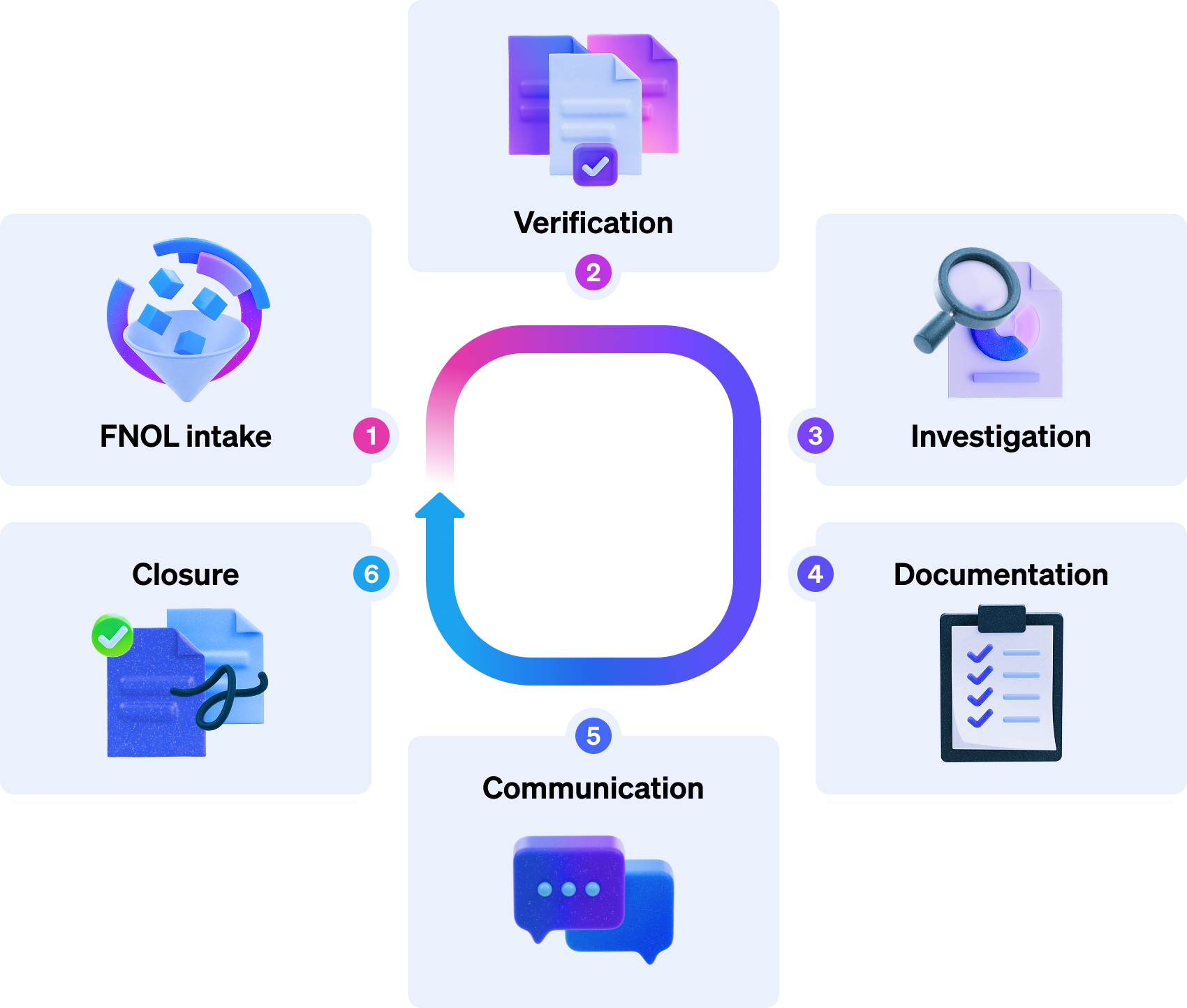
Each stage of the claims cycle carries more weight when you see cycle time explained as a measure of operational decisions rather than just a number. Cycle time encompasses FNOL intake, verification, investigation, documentation, communication, and closure. Each stage represents either a potential bottleneck or an acceleration point, and small improvements at any stage compound across your full book of claims.
The claims timeline is personal for your policyholders. Every open day on the claims timeline means your policyholder is without a vehicle or managing property damage. Policyholders perceive 11 days as a fair resolution time. When your cycle time exceeds that threshold, satisfaction scores decline, and the likelihood of them switching carriers increases.
The operational impact is equally significant. Loss Adjustment Expenses (LAE) rise as claims remain open longer, requiring repeated touchpoints and rework. Your adjusters lose capacity when manual processes consume time that could go toward new filings.
Multi-exposure losses, catastrophe (CAT) surges, rising repair costs, and fragmented data sources all extend resolution times. Every handoff across systems or teams introduces manual review and reformatting. Understanding where your claims cycle time stands relative to the industry is the first step toward closing the gap.
Benchmarks: What a strong claims cycle time looks like
Claims cycle time benchmarks vary by line of business and complexity across insurance. Here's what carriers typically see across major lines, based on market observations:
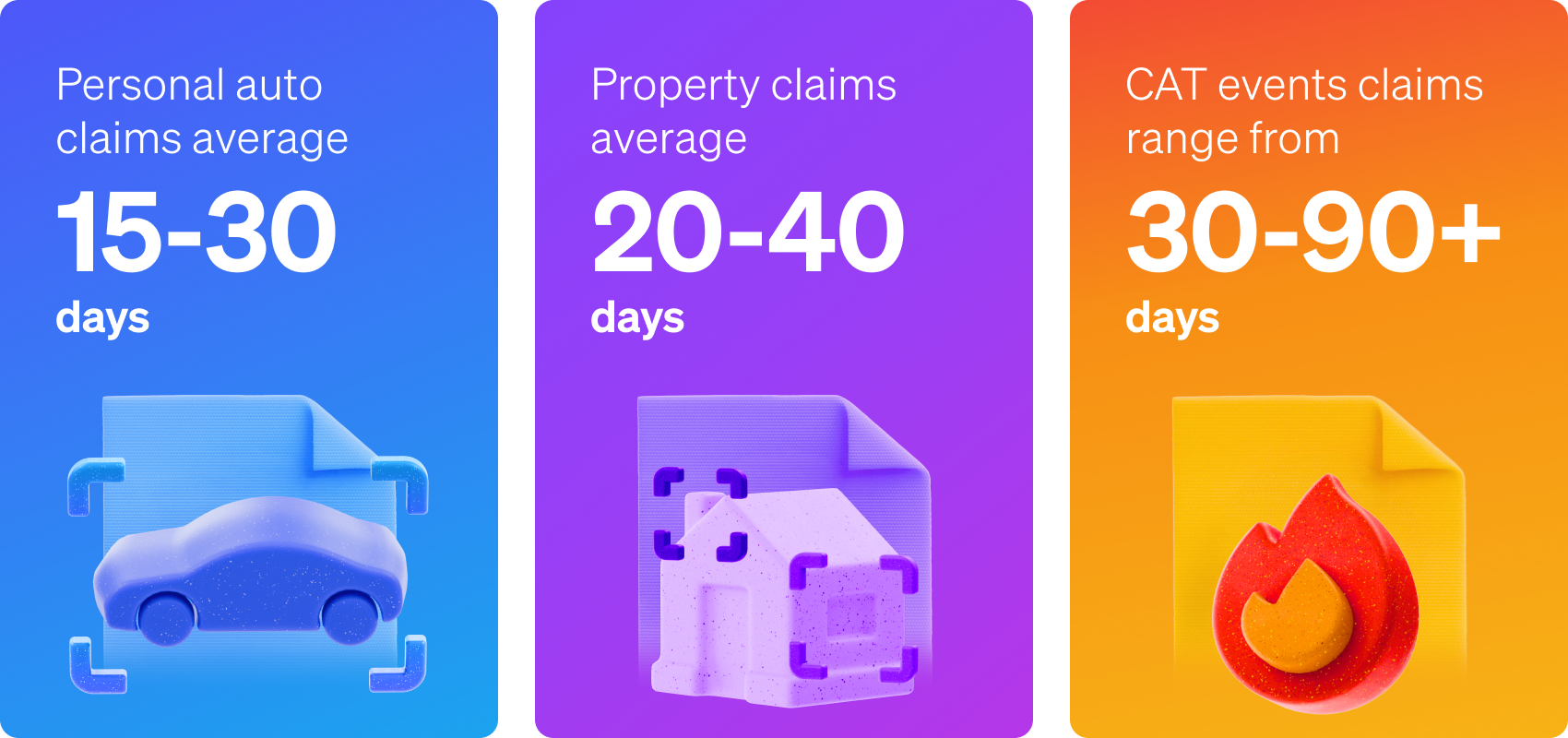
- Personal auto claims average 15-30 days, with digital-first carriers consistently hitting the lower end of that range.
- Property claims average 20-40 days, reflecting the additional coordination required for inspections, contractor estimates, and documentation.
- CAT events claims range from 30-90+ days, depending on event severity and volume, particularly when carriers lack proactive CAT detection and triage.
These benchmarks reveal where improvement is most achievable. The carriers reaching the lower end of each range share a common foundation: structured, machine-readable data captured at FNOL. When your intake process produces clean, standardized data from the first interaction, automation can reduce friction at every downstream stage of the claims cycle.
The structured data advantage
According to the International Association of Insurance Supervisors (IAIS), AI adoption allows carriers to achieve necessary cost reductions at scale while maintaining profitability. However, AI solutions only deliver results when built on quality data from the first interaction.
Without structured data at intake, automation simply reorganizes manual processes. With structured data, your operation unlocks intelligent triage, autonomous documentation gathering, and straight-through processing for routine claims. Benchmarks tell you where the industry stands. Understanding what keeps your operation from reaching them is where the real leverage sits.
What slows down claims cycle time?
The most common bottlenecks affecting claims cycle time stem from information gaps and workflow inefficiencies between systems and teams.
Low-quality FNOL data is the most significant factor. Your adjusters spend considerable time on manual re-entry when initial intake arrives as free text, phone notes, or incomplete forms. This added time adjusters spend is before evaluation can even begin. Routing and triage errors compound the issue, and days pass before reassignment occurs because claims reached the wrong queue. The ability to flag potential fraud at intake similarly affects timelines. Legitimate filings move through your pipeline more efficiently when suspect activity is identified early.
After FNOL, several operational bottlenecks extend the claims timeline further:
- Documentation gaps force your adjusters to wait for photos, receipts, police reports, or medical records. Each missing item triggers additional follow-up calls that increase adjuster workload and policyholder inconvenience.
- Fragmented communication channels create friction when claims activity spans email, phone, and text without a centralized system. Tracking what has been requested, received, or is still outstanding becomes a manual exercise.
- Legacy system limitations amplify every other bottleneck. When your claims management system cannot support modern workflows, every improvement requires workarounds that add complexity rather than removing it.
Each of these bottlenecks points to the same underlying cause: the data and workflow foundation your operation runs on.
How to improve claims cycle time: Proven strategies
Reducing claims cycle time requires addressing data quality and workflow efficiency together. The following strategies represent the operational and technology-driven levers that produce measurable results.
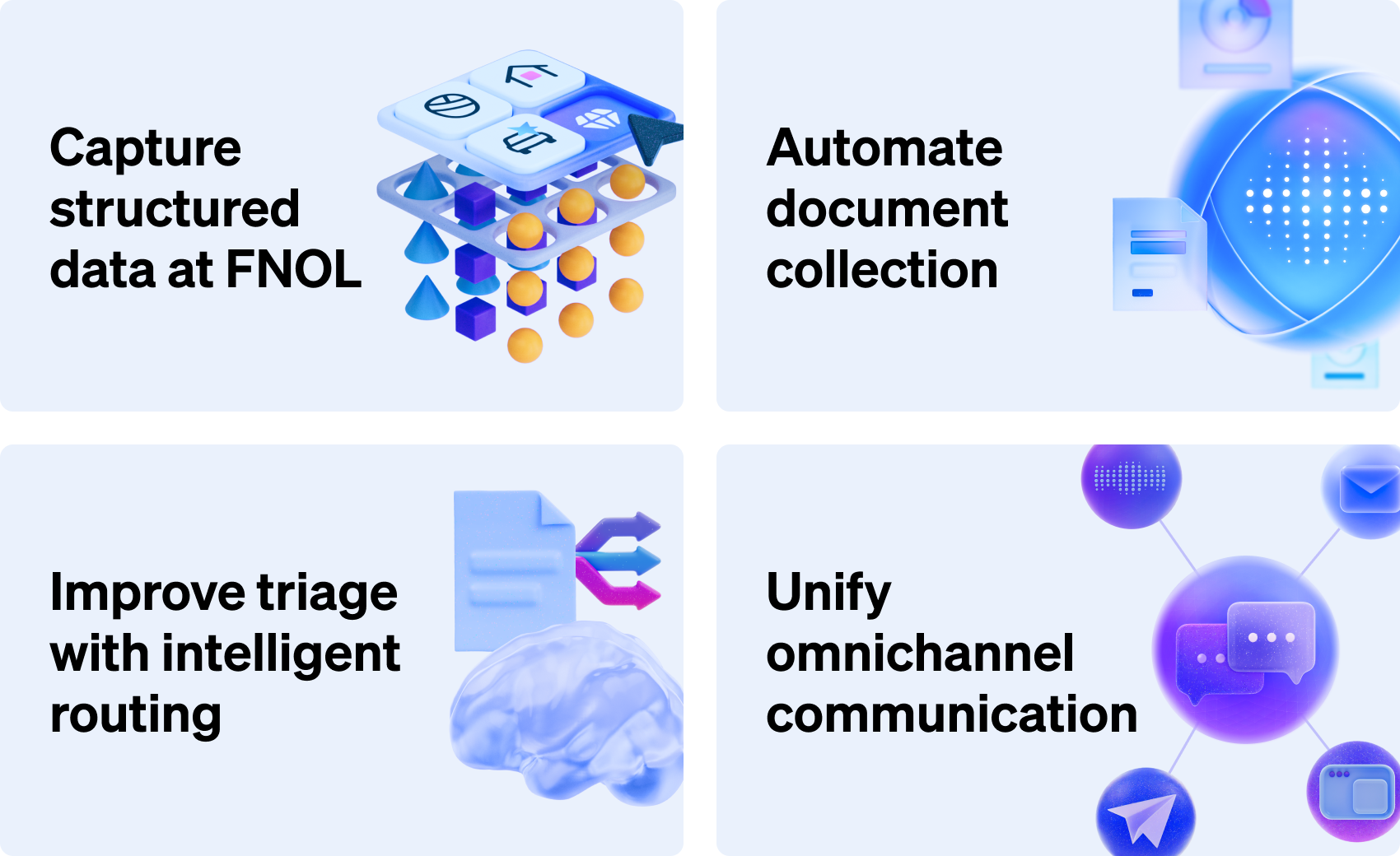
Strategy 1: Capture structured data at FNOL
Quality data at FNOL reduces manual data entry by 70%, freeing your adjusters to focus on evaluation and resolution. As McKinsey notes, AI is already transforming claims accuracy and productivity by dynamically evaluating adjuster notes, damage images, and claim histories at every stage of the lifecycle.
Assured's digital FNOL solution captures machine-readable, standardized data from the very first interaction, improving completeness on initial contact and powering everything downstream.
Digital, self-service FNOL captures structured data from one channel. Extending that same data quality to call center intake ensures consistency across every point of entry. Sidekick automates your telephonic FNOL, guiding agents through dynamic, rules-based flows so every claim is captured consistently, regardless of who answers the call. The result is quality data across all intake channels, creating a unified foundation for true automation.
Strategy 2: Automate routine documentation collection
After FNOL, documentation gathering is one of the most time-intensive stages for your adjusters. Gathering documentation is also one of the most straightforward to automate. During initial outreach, Assured’s digital First Contact solution reaches out to all involved parties, collecting documents and information without adding to your adjusters’ workload.
The same principle applies to routine communication. Agentic AI can gather missing documents, answer policyholder questions around the clock, and keep all parties informed without adjuster intervention. Assured's Emma handles approximately 70% of these routine interactions autonomously.
Battle-tested across millions of interactions, Assured Messaging and Emma solutions are equipped with smart safeguards to navigate complex, high-stakes conversations, escalate when needed, and protect sensitive information.
Strategy 3: Improve triage accuracy with intelligent routing
Incorrect routing adds days to your claims cycle time and requires reassignment that affects both your adjusters and policyholders.
AI-supported routing built on structured intake data ensures correct adjuster assignment from the start. High-cost reassignments decline when your triage decisions are informed by complete, standardized claim data, and your claims reach the right person on the first attempt.
For example, a water damage claim with photographic evidence and a completed loss description can be routed directly to a property adjuster with the appropriate authority level, bypassing general intake queues entirely. That single routing decision can save two to three days on the claims timeline.
For carriers using Assured, structured data captured at FNOL directly informs routing logic, creating a tighter feedback loop between intake quality and downstream efficiency.
Strategy 4: Unify omnichannel claims communication
When claims communication is scattered across text, email, and web chat, your adjusters lose time toggling between channels and reconstructing conversation history. Multiply that by dozens of involved parties per claim, and communication management becomes a workflow in itself.
Assured’s omnichannel claims messaging platform consolidates all communication into a single inbox. Every conversation across SMS, email, and web chat flows into one place, giving your adjusters a centralized view of all policyholder communications. The system supports auto-translate, e-signatures, coordination with up to 50 individuals per claim, smaller discussion groups, and direct messaging to individual participants.
Accelerate your claims cycle time with structured data
Each of the four strategies reinforces the others. Structured data captured at FNOL flows through triage, documentation, and communication, creating a claims operation where speed, consistency, and policyholder experience improve together.
Carriers using Assured's structured data platform see measurable improvements across their operations, including four to six days faster settlement, three to five fewer calls per claim, and 84% digital flow completion. These efficiency gains translate directly to lower LAE and stronger policyholder NPS.
Assured's modular solutions integrate with your existing core systems. Carriers typically deploy in under six months and achieve positive return on investment in under 12 months. Transaction-based pricing means you see value on a per-claim basis from the start.
Ready to test how structured data at FNOL accelerates your claims operation? Book a 30-minute Assured demo to see it in action.
Last modified on August 25, 2026

Subscribe for updates
You might also like

Claims automation: How AI is reshaping P&C operations
Increase efficiency, reduce friction, and accelerate decisions with AI-powered claims automation.
By The Assured Team


Subscribe for updates
By providing your email, you indicate you have read and understood our Privacy Policy.